
maxkle1nz/omx-codex-app-bridge
OfficialCodex skill and wrapper to run oh-my-codex from Codex App with project-local isolation.
2ShellMIT1 members
README from GitHub
README.md
context ready
Open 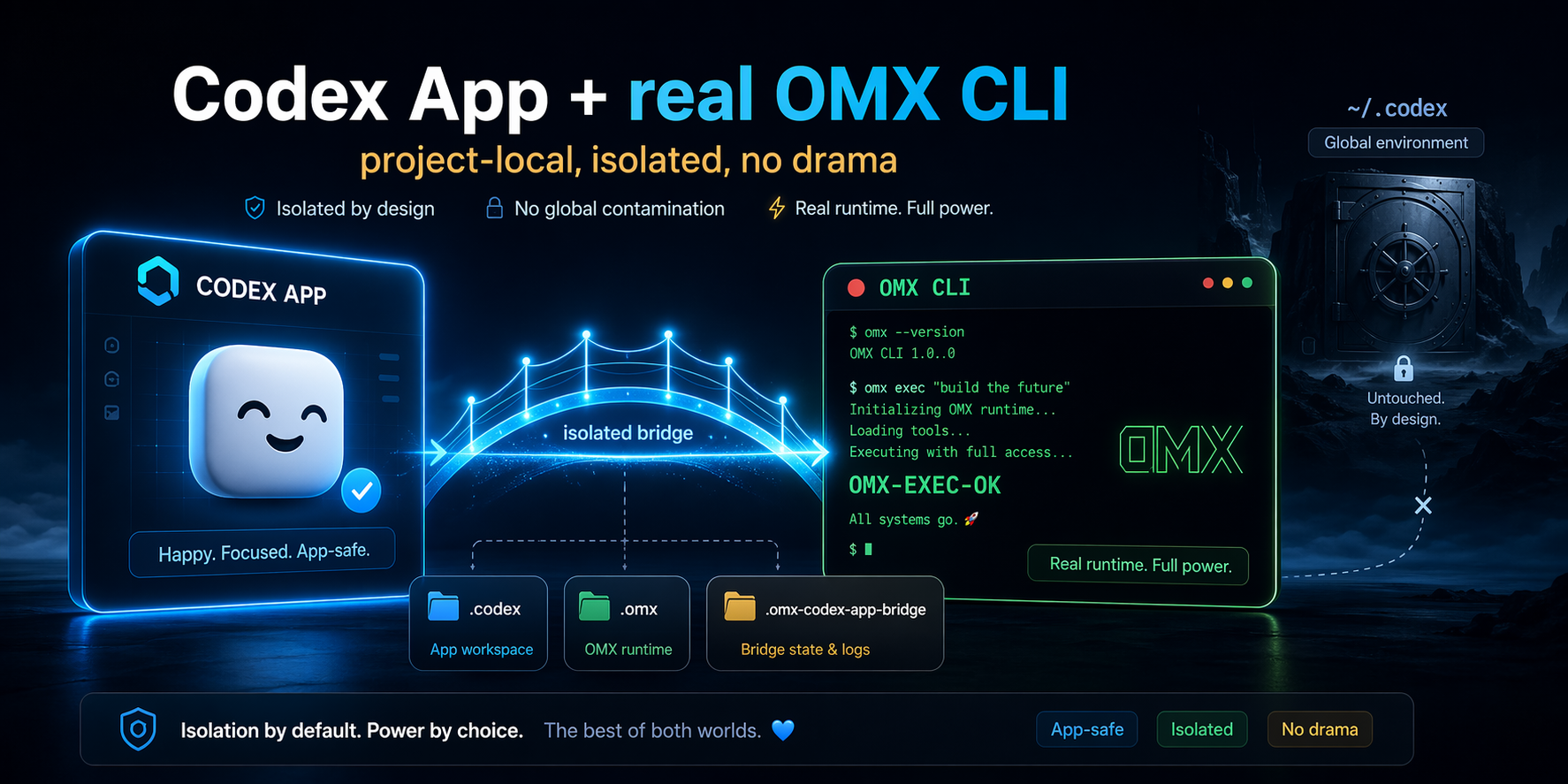
OMX Codex App Bridge
Bridge oh-my-codex (OMX) into Codex App safely by keeping the real OMX runtime in the shell and the App session honest about what is and is not active.
This repo ships a single public skill, omx-codex-app-bridge, plus a shell wrapper that:
- bootstraps upstream
Yeachan-Heo/oh-my-codexlocally - keeps OMX project-local under
./.codex,./.omx, and./.omx-codex-app-bridge - avoids global
npm -ginstalls - avoids upstream
postinstallside effects by building withnpm --ignore-scripts - gives Codex App a safe contract: App-safe guidance by default, real OMX runtime only when launched from the shell
Requirements
- Codex with the built-in
skill-installersystem skill available gitnodenpm
Security model
This bridge is safer than a global OMX install, but it is not a sandbox.
./.codex/isolation separates auth, config, skills, and runtime state from~/.codex- it does not restrict filesystem, network, or subprocess access available to your user account
- safe defaults reduce surprise, but only the underlying Codex sandbox and approval settings control model execution privileges
The wrapper therefore uses these launch modes:
launch: safe default, runs upstream OMX with--highlaunch-dangerous: explicit dangerous mode, runs upstream OMX with--madmax --high
Use launch-dangerous only when you intentionally want upstream OMX to bypass Codex approvals and sandboxing.
Why this exists
The upstream OMX README says Codex App is not the default experience and may behave inconsistently. This bridge does not try to fake OMX runtime behavior inside the App.
Instead, it teaches the App-side agent to do two things correctly:
- Stay App-safe when the user only wants planning, clarification, or native Codex help.
- Launch the actual OMX runtime from the shell when the user explicitly wants real OMX behavior.
That split is the core safety rule.
What gets created in a target project
When you use the wrapper from a project directory, state stays local to that project:
./.codex/for the isolated Codex home used by OMX./.omx/for upstream OMX runtime state./.omx-codex-app-bridge/for the local OMX checkout, wrapper logs, and bridge metadata
The wrapper never copies or syncs ~/.codex/auth.json, ~/.codex/config.toml, or other global Codex files.
Skill layout
skills/
└── omx-codex-app-bridge/
    ├── SKILL.md
    ├── agents/openai.yaml
    └── scripts/omx-bridge.sh
When Codex uses the installed skill, the wrapper path should be resolved from the skill directory, not from the user's repository:
BRIDGE_SCRIPT="${CODEX_HOME:-$HOME/.codex}/skills/omx-codex-app-bridge/scripts/omx-bridge.sh"
Install the skill
Use the built-in Codex skill-installer script:
INSTALLER="${CODEX_HOME:-$HOME/.codex}/skills/.system/skill-installer/scripts/install-skill-from-github.py"
python3 "$INSTALLER" \
  --repo <owner>/<repo> \
  --ref main \
  --path skills/omx-codex-app-bridge
Or install from a direct GitHub URL:
INSTALLER="${CODEX_HOME:-$HOME/.codex}/skills/.system/skill-installer/scripts/install-skill-from-github.py"
python3 "$INSTALLER" \
  --url https://github.com/<owner>/<repo>/tree/main/skills/omx-codex-app-bridge
After installation, restart Codex so it picks up the new skill.
Notes:
- the installer aborts if the destination skill directory already exists
- private repositories require working git credentials or
GITHUB_TOKEN/GH_TOKEN - you can still install manually by copying
skills/omx-codex-app-bridge/into your active$CODEX_HOME/skills/
Typical flow
Run the wrapper from the target project directory, or set OMX_PROJECT_ROOT explicitly if the script lives elsewhere.
From the project where you want OMX:
OMX_PROJECT_ROOT="$PWD" "$BRIDGE_SCRIPT" bootstrap
OMX_PROJECT_ROOT="$PWD" "$BRIDGE_SCRIPT" setup
OMX_PROJECT_ROOT="$PWD" "$BRIDGE_SCRIPT" codex-login-status
OMX_PROJECT_ROOT="$PWD" "$BRIDGE_SCRIPT" codex-login-device
OMX_PROJECT_ROOT="$PWD" "$BRIDGE_SCRIPT" doctor
OMX_PROJECT_ROOT="$PWD" "$BRIDGE_SCRIPT" launch
Use generic passthrough when you need a specific upstream command:
OMX_PROJECT_ROOT="$PWD" "$BRIDGE_SCRIPT" omx team 3:executor "fix the failing tests"
OMX_PROJECT_ROOT="$PWD" "$BRIDGE_SCRIPT" exec --skip-git-repo-check -C . "Reply with exactly OMX-EXEC-OK"
OMX_PROJECT_ROOT="$PWD" "$BRIDGE_SCRIPT" question --help
OMX_PROJECT_ROOT="$PWD" "$BRIDGE_SCRIPT" launch-dangerous
Supported environment variables
OMX_PROJECT_ROOT: target project root; defaults to the current working directoryOMX_REPO_URL: upstream OMX repo URLOMX_REPO_REF: upstream commit, tag, or branch; defaults tod56148c2020454acb37082d251f9a6ee9dba9f82OMX_SOURCE_DIR: local checkout path; defaults to./.omx-codex-app-bridge/vendor/oh-my-codexOMX_ENTRYPOINT: explicit upstream OMX entrypoint overrideCODEX_BIN: Codex CLI binary overrideNODE_BIN,NPM_BIN,GIT_BIN: tool overridesOPENAI_API_KEY: used only bycodex-login-api-key
Upstream pin
The default upstream checkout is pinned to the tested oh-my-codex commit:
d56148c2020454acb37082d251f9a6ee9dba9f82
Override OMX_REPO_REF only when you intentionally want a different upstream revision.
Command summary
bootstrap: clone or reuse the local OMX source checkout, then install deps with--ignore-scriptsand buildsetup: runomx setup --scope projectagainst the local projectdoctor: runomx doctorlaunch: run upstream OMX with default args--highlaunch-dangerous: run upstream OMX with explicit dangerous args--madmax --highexec: runomx exec ...with local auth gatingquestion: runomx question ...with local auth gatingomx: generic passthrough to the upstream OMX CLIstatus: print resolved paths plus local login statuscodex-login-status: inspect the project-local Codex auth statecodex-login-device: perform project-local device authcodex-login-api-key: log in withOPENAI_API_KEY, project-local only
Auth note
codex-login-api-key only works with a real OpenAI API key. If your main ~/.codex/auth.json is backed by ChatGPT account tokens instead of OPENAI_API_KEY, that is not reusable for this flow and should not be copied into the project. In that case, use codex-login-device for the isolated project login.
Testing
Run the wrapper smoke tests with:
bash tests/test-omx-bridge.sh
The tests use stub codex and omx executables and verify:
- project-local auth only
- no fallback to global Codex home
setupuses project scopelaunchuses--highlaunch-dangeroususes--madmax --high- auth-gated commands fail cleanly before runtime launch
Portugues

Este repositório publica uma skill para integrar o oh-my-codex com o Codex App sem fingir que o runtime OMX está ativo quando ele não está.
A regra é simples:
- Se a pessoa só quer ajuda no App, a skill mantém o fluxo App-safe.
- Se a pessoa quer o runtime real do OMX, a skill lança o OMX pelo shell, com tudo local ao projeto.
O bootstrap do upstream é feito localmente em ./.omx-codex-app-bridge/vendor/oh-my-codex, com npm --ignore-scripts, justamente para evitar efeitos colaterais inesperados do postinstall.
O isolamento criado aqui é de estado e configuração, não de privilégios do sistema operacional. Por isso o wrapper separa:
launch: modo padrão mais seguro, sem--madmaxlaunch-dangerous: modo explícito para quem realmente quer o bypass de approvals e sandbox do Codex
Para autenticação local, codex-login-api-key só serve quando existe uma API key real da OpenAI. Se o ~/.codex principal estiver autenticado por sessão da conta ChatGPT, o fluxo correto para o projeto isolado é codex-login-device.
O checkout upstream do oh-my-codex fica pinado por padrão no commit testado d56148c2020454acb37082d251f9a6ee9dba9f82. Se quiser outro upstream, aí sim você sobrescreve OMX_REPO_REF.
Os diretórios importantes no projeto-alvo são:
./.codex/./.omx/./.omx-codex-app-bridge/
Ou seja: sem instalar globalmente, sem copiar credenciais de ~/.codex, e sem contaminar a instalação principal do Codex.
Room context
Read the project first. The room is where the next question becomes a conversation.
# showcase
Room chat
Join the room to talk.
Read the room now, then continue with GitHub when you want to post.